I know that President Trump, his administration, and his die hard supporters will just scream "fake news," but can't help but be somewhat stunned when a well established conservative publication like The National Review publishes something like this article. I suppose, however, that it is unavoidable due to the complete ineptitude displayed by the Trump Administration nearly three months into assuming the office.
The first 100 days is typically a time where a new administration passes a good many new initiatives, strengthened by the political capital and "mandate" stemming from the election. In the case where the President has entered office without a resounding mandate, such as the 2000 election and George W. Bush, the administration has typically worked aggressively with the other party to achieve bipartisan legislative achievements. These are the two options, historically and for good reason: if you have the capital you should use it before circumstances dictate that you lose it. If you don't have the capital, working with the other side can garner respect and support in the event that you gain it in the future.
The Trump Administration, inexplicably, has seemingly settled on a third option: go to war with everyone. Accordingly, it seems likely at this point that they will end their first 100 days without a single headline achievement on which to rest their hats. The buildup to the midterm election will be fast and furious this time around, similar to what was observed in 1994 or 2010. An Administration without a mandate (no President in modern times has had less of a mandate than President Trump did upon taking the oath of office) has decided to try to operate by strong arming people. He has served to stir up the opposition to the point where they are apparently poised to oppose nearly everything. He has also served to further fracture his own party, splitting off extreme and moderate portions of his party already.
In sum, it is inarguable at this point that this administration is ill equipped for the responsibility of governing. With issues spiraling out of control in the realm of foreign policy (Syria and North Korea most disconcertingly), and with their own administration in the line of fire for a series of apparent lies told by campaign and administration personnel regarding their own involvement with Russia, as well as the President's own inability to stay out of his own way on social media, it seems simultaneously essential that the administration somehow rush through their own steep learning curve and catastrophically impossible that they can learn at all. Three months in things look bad. They are poised to look a lot worse in three months if there isn't a miraculous turnaround hidden just out of sight.
Wednesday, April 12, 2017

Wednesday, April 5, 2017
What The Health Care Failure Means
An insane amount has happened in the last twenty plus days. I'm back, albeit in a shortened version due to time constraints. That said, I wanted to dip my toe in and give some brief analysis on the failure of the GOP to pass their own "health care" bill, leading to Speaker Ryan saying that the Affordable Care Act would be the law of the land for the foreseeable future.
The fundamental flaw in the GOP attempt was that the bill, while positioned as a health care reform bill, was actually anything but. The bill fundamentally did a few things. It cut taxes, predominately on the wealthiest of Americans. It shifted the cost of healthcare from the federal government to state governments. It rolled back many regulations in the ACA which were put in place to help control costs. And it ultimately projected to reduce the deficit over ten years, while controlling the rising cost of healthcare within a decade, ever so slightly, at the cost of roughly 24 million Americans losing insurance.
None of that actually tackles the problem of health care in this country. The USA is by and large one of the least heavily taxed nations in the industrialized/western world. In fact, the other nations, taken together and averaged, have a tax rate roughly ten percent higher than the US rate. Only two counties (Mexico and Chile) have lower rates than the USA. In spite of significantly reducing the tax burden on citizens over the last fifty years, the government has not reigned in spending. Accordingly, deficits continue to grow, damaging the country's financial stability long term. That, in turn, leads to a great hesitation to spend in areas like health care, where it is an unassailable fact that the uninsured lead to the greatest degree of unpaid cost in the system, which, in turn, is the primary contributing factor to the increasing cost of health care that everyone else feels.
Since the end of the Reagan years the top tax rate in the USA has sat between 39.6% (Clinton years) and 28% (end of Reagan's second term). More specifically, through the last three Presidency's the rate been no higher than 39.6% and no lower than 35%. Prior to Reagan, however, the tax rate sat between 70% and 77% for nearly 20 years, and was significantly higher than that throughout world war two and the ensuing two decades. Many of the "Reagan Democrats" in the Rust Belt talk of wanting to go back to an economy that existed in the 1950s and 1960s. I've talked here before about some of the reasons why that is impractical and impossible, but looking at the tax rates that were involved during that period of time is yet another factor.
What does all this have to do with health care? Well, first, the GOP "attempt" to "repeal and replace" the Affordable Care Act was actually an attempt to repeal parts of the ACA and to cut taxes. There wasn't any functional aspect to it that dealt with the issues facing our health care system. In no particular order, those issues are:
1. Costs which are spiraling out of control, due to;
2. Malpractice lawsuits being around every corner, leading to
3. Increasing costs for malpractice insurance for medical providers.
Additionally:
4. Uninsured people going to the ER to get medical care for any medical concern, because hospitals cannot refuse them care, then
5. Not paying their bills, leading to
6. Hospitals losing money, leading to
7. Medical providers increasing the price they charge for services, leading to
8. Government health care providers refusing to pay the high price, leading to
9. an ever smaller network of providers who will accept Medicare and Medicaid, leading to
10. Fewer choices and
11. High costs in premiums and deductibles for everyone.
I could go on and on with this list, but that's the general gist. In the midst of this the GOP claims to want to reform healthcare, but if their first attempt is any indication they haven't even really given the problems with the system much thought. In fact, given that their first attempt would have uninsured another 24 million people, one could argue that they were willing to exacerbate many of these problems to give the best off in this country even more money in their pockets. But look back at those tax rates I mentioned earlier: do people really, really need that additional money in their pockets? And, if they have it, will it even pay for their increased medical costs?
Ultimately, the two extremes of this debate are to go with a government run single payer system (universal health care as a right), or to remove all legislation mandating care, making it so that health care is truly governed by the forces of capitalism (if you can't pay you don't get the service, period). In between is where we've been for sometime, and where we figure to be for sometime more. Ultimately, what his failure to pass a repeal and replace means is that the GOP spent seven years running against the ACA without actually coming up with a plan to replace it. It also means that they might be far better suited to being the minority party than the majority. Governing is hard after all.
The fundamental flaw in the GOP attempt was that the bill, while positioned as a health care reform bill, was actually anything but. The bill fundamentally did a few things. It cut taxes, predominately on the wealthiest of Americans. It shifted the cost of healthcare from the federal government to state governments. It rolled back many regulations in the ACA which were put in place to help control costs. And it ultimately projected to reduce the deficit over ten years, while controlling the rising cost of healthcare within a decade, ever so slightly, at the cost of roughly 24 million Americans losing insurance.
None of that actually tackles the problem of health care in this country. The USA is by and large one of the least heavily taxed nations in the industrialized/western world. In fact, the other nations, taken together and averaged, have a tax rate roughly ten percent higher than the US rate. Only two counties (Mexico and Chile) have lower rates than the USA. In spite of significantly reducing the tax burden on citizens over the last fifty years, the government has not reigned in spending. Accordingly, deficits continue to grow, damaging the country's financial stability long term. That, in turn, leads to a great hesitation to spend in areas like health care, where it is an unassailable fact that the uninsured lead to the greatest degree of unpaid cost in the system, which, in turn, is the primary contributing factor to the increasing cost of health care that everyone else feels.
Since the end of the Reagan years the top tax rate in the USA has sat between 39.6% (Clinton years) and 28% (end of Reagan's second term). More specifically, through the last three Presidency's the rate been no higher than 39.6% and no lower than 35%. Prior to Reagan, however, the tax rate sat between 70% and 77% for nearly 20 years, and was significantly higher than that throughout world war two and the ensuing two decades. Many of the "Reagan Democrats" in the Rust Belt talk of wanting to go back to an economy that existed in the 1950s and 1960s. I've talked here before about some of the reasons why that is impractical and impossible, but looking at the tax rates that were involved during that period of time is yet another factor.
What does all this have to do with health care? Well, first, the GOP "attempt" to "repeal and replace" the Affordable Care Act was actually an attempt to repeal parts of the ACA and to cut taxes. There wasn't any functional aspect to it that dealt with the issues facing our health care system. In no particular order, those issues are:
1. Costs which are spiraling out of control, due to;
2. Malpractice lawsuits being around every corner, leading to
3. Increasing costs for malpractice insurance for medical providers.
Additionally:
4. Uninsured people going to the ER to get medical care for any medical concern, because hospitals cannot refuse them care, then
5. Not paying their bills, leading to
6. Hospitals losing money, leading to
7. Medical providers increasing the price they charge for services, leading to
8. Government health care providers refusing to pay the high price, leading to
9. an ever smaller network of providers who will accept Medicare and Medicaid, leading to
10. Fewer choices and
11. High costs in premiums and deductibles for everyone.
I could go on and on with this list, but that's the general gist. In the midst of this the GOP claims to want to reform healthcare, but if their first attempt is any indication they haven't even really given the problems with the system much thought. In fact, given that their first attempt would have uninsured another 24 million people, one could argue that they were willing to exacerbate many of these problems to give the best off in this country even more money in their pockets. But look back at those tax rates I mentioned earlier: do people really, really need that additional money in their pockets? And, if they have it, will it even pay for their increased medical costs?
Ultimately, the two extremes of this debate are to go with a government run single payer system (universal health care as a right), or to remove all legislation mandating care, making it so that health care is truly governed by the forces of capitalism (if you can't pay you don't get the service, period). In between is where we've been for sometime, and where we figure to be for sometime more. Ultimately, what his failure to pass a repeal and replace means is that the GOP spent seven years running against the ACA without actually coming up with a plan to replace it. It also means that they might be far better suited to being the minority party than the majority. Governing is hard after all.
Wednesday, March 15, 2017
So, She's Really Not ... Right?
In this post I talked a bit about Hillary Clinton and her team thinking about what the future might bring. Well, in the interim, two competing articles were published. The first, from Politico, comes right out to declare that Clinton will run for President, yet again, in 2020. The second, from The Washington Post, talks about the importance of Democrats stopping Clinton from running again, and declares that she absolutely should not run again.
If you read my first post you know where I stand on this one. I can't fathom Clinton running again, at her age, after being the victim of two huge upsets. Her team collapsed against a relatively unknown Freshman Senator in 2008, and then lost the last election to an opponent who had unprecedentedly low scores in the areas of trustworthiness and likeability. Simply put, voters have made it pretty clear that they don't trust Clinton, don't believe she'd be good for the country, and that, alone, should dissuade her from running again.
Of course, Clinton loyalists will always turn to something: that Obama didn't wait his turn, that the FBI screwed her in this election, that she won the popular vote. But that misses the point. Any truly dynamic candidate never would have lost to an opponent as inexperienced as Obama; they would have beaten Obama and had him as the Vice Presidential nominee. A quality candidate never would have lost to Trump; they would have watched as he self-destructed and would have focused on reinforcing the only areas of the map where Trump could mount his counter measure (the Rust Belt), rather than largely ignoring them.
Nothing would surprise me. Hillary Clinton has spent her life, seemingly, in pursuit of the White House in one way or another, so if she feels she has the drive it wouldn't be shocking for her to put her name in at some point during the run up to 2020. That said, if she does it there will be no possible way to refute the overriding narrative: that she is doing this solely for herself and her own ego, rather than her party or, if she truly believes the Democrats are better for the country, the country itself.
If you read my first post you know where I stand on this one. I can't fathom Clinton running again, at her age, after being the victim of two huge upsets. Her team collapsed against a relatively unknown Freshman Senator in 2008, and then lost the last election to an opponent who had unprecedentedly low scores in the areas of trustworthiness and likeability. Simply put, voters have made it pretty clear that they don't trust Clinton, don't believe she'd be good for the country, and that, alone, should dissuade her from running again.
Of course, Clinton loyalists will always turn to something: that Obama didn't wait his turn, that the FBI screwed her in this election, that she won the popular vote. But that misses the point. Any truly dynamic candidate never would have lost to an opponent as inexperienced as Obama; they would have beaten Obama and had him as the Vice Presidential nominee. A quality candidate never would have lost to Trump; they would have watched as he self-destructed and would have focused on reinforcing the only areas of the map where Trump could mount his counter measure (the Rust Belt), rather than largely ignoring them.
Nothing would surprise me. Hillary Clinton has spent her life, seemingly, in pursuit of the White House in one way or another, so if she feels she has the drive it wouldn't be shocking for her to put her name in at some point during the run up to 2020. That said, if she does it there will be no possible way to refute the overriding narrative: that she is doing this solely for herself and her own ego, rather than her party or, if she truly believes the Democrats are better for the country, the country itself.
Wednesday, March 8, 2017
A New Cold War? One New Yorker Article Hypothesizes As Much
This article, posted in the New Yorker, takes a deep dive into the world of foreign relations as it relates to the United States and Russia. The article is certainly an interesting take to consider. I would implore people out there to take in information like this, and to consider what it might mean moving forward. The far right media will cry foul throughout this process, accusing the process of "media bias" or being "fake news," but in reality there is much more meat on the bones than they'd want to admit.
The interesting thing about this current Administration's (mostly) overt pro-Russian bent is how counter it runs to the general GOP's recent approach to Russia. Using history as a lens through which to view current relations between the countries is not only practical, but a proven method for trying to decode international relations and what's likely to happen going forward. The same rationale applies to looking at the fall of democracies and empires past when looking at our own governmental institutions. Doing so isn't the same as saying those things will happen, but simply indicates that the possibility is always there, and being aware of what things were antecedents in the past might help to avoid a similar fate in the present.
In sum, I'd encourage you to read the article linked above, regardless of your viewpoint. It doesn't hurt to broaden our horizons and consider possible outcomes, no matter how plausible we individually believe they might be. After all, I doubt too many Romans foresaw the fall of Rome in the way it ultimately happened, nor did citizens of the British Empire at the turn of the 20th century. Time is relentless, and, as the saying goes, those ignorant of history are bound to repeat it.
The interesting thing about this current Administration's (mostly) overt pro-Russian bent is how counter it runs to the general GOP's recent approach to Russia. Using history as a lens through which to view current relations between the countries is not only practical, but a proven method for trying to decode international relations and what's likely to happen going forward. The same rationale applies to looking at the fall of democracies and empires past when looking at our own governmental institutions. Doing so isn't the same as saying those things will happen, but simply indicates that the possibility is always there, and being aware of what things were antecedents in the past might help to avoid a similar fate in the present.
In sum, I'd encourage you to read the article linked above, regardless of your viewpoint. It doesn't hurt to broaden our horizons and consider possible outcomes, no matter how plausible we individually believe they might be. After all, I doubt too many Romans foresaw the fall of Rome in the way it ultimately happened, nor did citizens of the British Empire at the turn of the 20th century. Time is relentless, and, as the saying goes, those ignorant of history are bound to repeat it.
Monday, March 6, 2017
When Politics Collides With Anything
Just a quick post for this Monday. We often hear actors or musicians speak out politically, and the backlash is almost always immediate from whatever side of the aisle they are not supporting. Athletes, however, are often more quiet than their celebrity peers. Not so for Dexter Fowler, recently of the World Series Champion Chicago Cubs (and now, sadly, playing for the St. Louis Cardinals). Fowler was asked about the impact of the Trump Administration's travel ban on his family. He is married to an Iranian woman, so it was a logical question.
It seemed like a fair, reasonable question. He responded, and in doing so seemed to incite a good portion of his new fan base, which tends to trend pretty conservative. Now, of course we know that the people most likely to comment like that are not representative of all people in a particular demographic. We also know how easy it is to act big and tough behind your keyboard. Trying to be yourself lends itself to being the worst of yourself when nobody can "catch" you. But there is no doubt in my mind that the question was fair, Fowler's response appropriate, and the overarching reaction was not as much fair or appropriate. Simply put, just because someone is an athlete, or a musician, or an actor, doesn't mean that they lose their right to their first amendment privileges. Just because Fowler will be heard in a much broader way than I am doesn't mean that he shouldn't say anything. Freedom of speech is something we all have, regardless of our chosen professions.
It seemed like a fair, reasonable question. He responded, and in doing so seemed to incite a good portion of his new fan base, which tends to trend pretty conservative. Now, of course we know that the people most likely to comment like that are not representative of all people in a particular demographic. We also know how easy it is to act big and tough behind your keyboard. Trying to be yourself lends itself to being the worst of yourself when nobody can "catch" you. But there is no doubt in my mind that the question was fair, Fowler's response appropriate, and the overarching reaction was not as much fair or appropriate. Simply put, just because someone is an athlete, or a musician, or an actor, doesn't mean that they lose their right to their first amendment privileges. Just because Fowler will be heard in a much broader way than I am doesn't mean that he shouldn't say anything. Freedom of speech is something we all have, regardless of our chosen professions.
Wednesday, March 1, 2017
Trump's Approval Ratings - How Can We Tell, What Do They Mean?
President Trump and his team have done a brilliant job of discrediting the media, even when the very thing they are discrediting is not accurate. For instance, take the polls. President Trump has mentioned many times how "off" the polls were when, in fact, they were more accurate than they were in 2012's Presidential Election. But, since they were just off enough in a handful of critical states, President Trump can bring this up again and again and his supporters will tend to agree blindly.
That pivots, nicely, into a discussion of the President's approval rating. We've already established that Donald Trump is the least popular President upon first term inauguration; President Trump now has another marker in this regard, as he has the lowest approval rating after one month in history, nearly 13 points lower than the prior record holder, Bill Clinton. The question, however, is are these polls "accurate?". Put another way, as Politico does in this article, "Donald Trump might be more popular than you think." Politico breaks down different ways in which Trump might be more popular than traditional metrics measure, and they use the polling error in the general election as one example of how this can happen.
Nate Silver's crew at 538 offer a different perspective, centered on what Trump's approval ratings mean for the GOP at large in the 2018 Midterm Elections. To get to that discussion the article doesn't dispute that the polls are saying different things, ranging from "approve of his job performance more than disapprove" to "underwater by anywhere from 7 percentage points ... to 15 points." The article then quiets all the noise by rightly pointing out that regardless of where on this spectrum Trump's approval actually lies doesn't matter: he is historically unpopular for a president within his first month.
As to what that means moving forward for President Trump, his Administration, or the GOP, it is really anyone's guess. It is possible that Trump's approval jumps up very high; look at George W Bush's approval post 9/11/01, or his father's post Desert Storm for one way that could happen. But the chaos inside the White House seems, at this point, to make that jump unlikely at best. Furthermore, almost all Presidents during the modern age have gotten more unpopular as their first term progresses. The exception to that rule? George W Bush, who got a net of 2 points more popular. If President Trump doesn't manage to buck that trend, things could get really ugly, really fast, for the GOP.
At any rate, this bears much more watching than usual, for two reasons. The first is that it is evident that the pollsters will be working hard to try to prove that they not only have an important role, but are accurate. The second is how much attention Trump pays to the polls. We know already that if a poll comes out that looks good for him he will trumpet it; if a poll comes out he doesn't like he will slam it. But one thing that is certain is that the general public's opinion of the President is a historically important factor in Midterm Elections. Will 2018 be any different?
Monday, February 27, 2017
The Folly In Trump's Manufacturing Promise
Then candidate Trump spent a great deal of time focusing on the Rust Belt, and much of his message involved bringing back the jobs which have left over the last number of decades. Trump focused on killing the Trans-Pacific Partnership, renegotiating or killing NAFTA, and his supposed ability to bully companies into bringing jobs back to the USA (or, even, keeping them here).
I've written about this already (click here if you missed it), and this conversation comes up often when discussing now President Trump, his promises, and what his supporters hope he will deliver on. Trump knows this; that's why he trumpets things like Carrier and Ford keeping jobs here, even as he glosses over how terrible the Carrier deal is for Indiana's citizens, or how Ford made the decision based on the market for small cars, rather than anything related to Trump.
The reality is this: people in the Rust Belt fantasize about returning to a time when the USA was the dominant manufacturing power in the world. Makes sense, right? These people have heard of (or, in some cases, even lived in) a time when the money was good, the benefits were insanely good, and the unions were so powerful that their bosses couldn't mess with them. What these people fail to realize is two things. First, the economic conditions that made that possible were almost entirely because of World War II, and the fact that the USA came out as the most unscathed world power, by far. Those conditions are not in existence anymore, making their fantasy impossible to make reality. Anyone telling them otherwise (including our President) is simply selling fool's gold.
The second point is even more important: if we bring all these jobs back, which will necessitate cutting taxes on these companies to the point where they aren't paying anything, it is simply temporary anyways. The fast majority of these jobs will be automated in the coming years to decades, so this is putting a band-aid on a gushing wound. Need more evidence? Read this article, on the future of artificial intelligence, or this one on the importance of automation.
Simply put, Trump is selling a false reality to people who are the most vulnerable to fantasy. If we go too far down this road it not only won't help, but it likely sets us up to be passed by other economies which focus on the future, rather than the past. The future is scary; if you have a skill set that is rapidly becoming unneeded you clearly should have a lot of angst. But moving forward is the only way to secure a prosperous future for our children and their children. Doing what President Trump has promised to do not only won't help the people who voted for him in the Rust Belt in the near term, but in the long term it will prove to be disastrous.
I've written about this already (click here if you missed it), and this conversation comes up often when discussing now President Trump, his promises, and what his supporters hope he will deliver on. Trump knows this; that's why he trumpets things like Carrier and Ford keeping jobs here, even as he glosses over how terrible the Carrier deal is for Indiana's citizens, or how Ford made the decision based on the market for small cars, rather than anything related to Trump.
The reality is this: people in the Rust Belt fantasize about returning to a time when the USA was the dominant manufacturing power in the world. Makes sense, right? These people have heard of (or, in some cases, even lived in) a time when the money was good, the benefits were insanely good, and the unions were so powerful that their bosses couldn't mess with them. What these people fail to realize is two things. First, the economic conditions that made that possible were almost entirely because of World War II, and the fact that the USA came out as the most unscathed world power, by far. Those conditions are not in existence anymore, making their fantasy impossible to make reality. Anyone telling them otherwise (including our President) is simply selling fool's gold.
The second point is even more important: if we bring all these jobs back, which will necessitate cutting taxes on these companies to the point where they aren't paying anything, it is simply temporary anyways. The fast majority of these jobs will be automated in the coming years to decades, so this is putting a band-aid on a gushing wound. Need more evidence? Read this article, on the future of artificial intelligence, or this one on the importance of automation.
Simply put, Trump is selling a false reality to people who are the most vulnerable to fantasy. If we go too far down this road it not only won't help, but it likely sets us up to be passed by other economies which focus on the future, rather than the past. The future is scary; if you have a skill set that is rapidly becoming unneeded you clearly should have a lot of angst. But moving forward is the only way to secure a prosperous future for our children and their children. Doing what President Trump has promised to do not only won't help the people who voted for him in the Rust Belt in the near term, but in the long term it will prove to be disastrous.
Wednesday, February 22, 2017
Trump's Presidency After A Month - Some Quick Hit Thoughts
Reality is a tough thing, and here is reality: I cannot possibly keep up with everything that this Administration is putting down. Not in my life, and certainly not if I attempt to write about all of it. For every one take I post there are at least half a dozen that fall by the wayside. This, of course, is part of the Trump strategy, both throughout the campaign and now into his Administration. Keep the ball constantly moving and don't let anyone (voters, Democrats, Republicans, the media) focus in on any one thing. This also benefits President Trump, as it did candidate Trump, by allowing so much noise that any misstep is quickly forgotten by the next.
And so, today, I introduce the "Quick Hits" post. This is intended to throw you, the reader, some links to articles I've read as I try to keep up with the political cyclone encompassing our country right now. I'll give you some brief analysis for each, but encourage you, as always, to read yourself and determine how what I present fits with your own analysis and worldview.
And so, today, I introduce the "Quick Hits" post. This is intended to throw you, the reader, some links to articles I've read as I try to keep up with the political cyclone encompassing our country right now. I'll give you some brief analysis for each, but encourage you, as always, to read yourself and determine how what I present fits with your own analysis and worldview.
- First things first: Trump and his 2/16/17 press conference. To say that there's been nothing like this in presidential history is an understatement. Trump ranted, went on tangents, and continued to bring up non-sequitur arguments with shocking frequency. His fascination with ratings, approval, and meaningless factoids (many of which are not facts, but falsehoods) would be entertaining if it wasn't coming from the Chief Executive of our Government and Commander in Chief of our Military.
- The story of Michael Flynn's (likely) illegal pre-inauguration activities, coupled with him lying to the Vice-President, coupled with the Administration knowing about the lies for weeks, not telling the Vice-President about the lies for weeks ... can you see what I mean about this Administration and how hard it is to stay on top of it? This story is still in the news, but has fallen off far quicker than it would have in any other previous Administration. That the Administration seemingly was not going to fire Flynn until it became public knowledge should raise major concerns about the ethical competency of this President and his Administration. Let's just say that there is a ton to unpack in this story, and many good reasons to want to do so. I hope that this is the thing that forces the GOP to stand up, starting with a thorough investigation of this situation, no matter where it may lead.
- While President Trump may be saying, to the press, that his Administration is running like a "fine tuned machine," plenty of other information indicates otherwise. With stories that President Trump is looking actively for fall persons within his Administration, and that much of that pressure is falling on Chief of Staff Reince Priebus, it is probably worth noting that Steve Bannon's Alt-Right opinion outlet, Breitbart, is pushing heavily for Priebus to be fired. It doesn't appear that everything is paradise within the West Wing after all, but given Trump's stated goal of creating conflict within his team by pitting people against each other this can't be much of a surprise.
- I would encourage you to read this series, from Nate Silver at 538, about the 2016 election. I haven't found a better retrospective/autopsy of what happened in 2016 and what it means moving forward. Recently, Silver talked about the Electoral College blind spot.
- Finally, a perspective on how ineffectual Trump and his Presidency might prove to be.
Monday, February 20, 2017
Checks and Balances
Then candidate Trump made a big deal throughout the presidential campaign about how he was not a politician. He said this with pride, talking about how he would "drain the swamp" and how he knew how to "get things done." Central to his entire campaign, then, was the promise that he would simultaneously not be a part of the Washington establishment while knowing how to do the job from day one.
Of course, where else do we see this type of marketing of oneself for a job? I couldn't walk into the prestigious Mayo Clinic and argue that I deserved a job as a surgeon because I was good at my current job and was not a surgical insider. Setting aside for a moment the legitimate questions regarding just how good Donald Trump was at his "job" before winning the Presidency, think back to this point: Trump said he was the right person for the job because he had no experience for the job.
Now imagine that the Mayo Clinic hires me as a surgeon. I come in, I scrub up, I go into the operating room. And then it hits me: it doesn't matter how good I was or wasn't in my old job, nor does it matter how good I was at selling the Mayo hiring team on me. Now I actually need to know how to do this. In other words, I'm probably in big trouble in this situation.
Name one profession besides politician in which there is such a fascination with putting inexperienced outsiders into key roles? There is typically a reason that people stay in politics beyond the self-serving, power hungry ones: they become good at what they do, and they like doing it, so they stay. That is not all together different than why I stay in my current career. But Trump did something that hasn't been done in our nation's history. It wasn't that he sold the outsider story managed to win the whole thing; Andrew Jackson did that back in the 1800s.
No, what Trump did was manage to actually be a functional outsider, in as much as he had no experience with politics or the political process. He then doubled down, putting an inexperienced administration around him in key positions, including much of his cabinet. So it can't really be that much of a surprise that Trump would roll out an Executive Order at some point that would be challenged successfully in the courts. What made the order that accomplished this so special is that, in many ways, the scope of what Trump was trying to do had been established as constitutional in the past. But a poor roll out, due to not preparing anyone in his Administration for the order, led to a hold in court. What happened next was particularly stunning to the system, if not at all surprising to those who have paid attention to Donald Trump throughout his career: President Trump attacked the Judiciary with reckless abandon.
Trump's actions almost assuredly helped to nudge the 9th circuit to unanimously decide against his Administration's appeal. Trump then vowed to fight on, in all CAPS, but predictably this was little more than hot air. At present it seems likely that his Administration will regroup, tail between their legs, and try to issue a more well thought out Executive Order on immigration next week. Of course, they will try to sell this not as a regrouping or retreat of any measure, and will instead try to spin this in some way attacking the "enemy." In this case, the court, as Trump has continued to do, most recently in his 80 minute marathon press conference on February 16th.
The upshot of this approach, however, is that it will only serve to further irritate the Courts at every level of this country. If the Trump Administration had played it cool it is possible that they might have won a stay, or at least a full appeal, at the 9th circuit. Furthermore, it was likely that the Supreme Court would have ruled in his Administration's favor, once Neil Gorsuch is confirmed (news flash: that's happening barring a huge surprise). I suspect strongly, however, that Trump's actions will have influenced Anthony Kennedy strongly, leading the "swing" vote on the court to be more likely to view the Trump Administration critically. Even beyond that, it is possible that the same thing has happened to John Roberts, the Chief Justice. If that is the case it is possible that even with Gorsuch, the Trump Administration may only have two other "safe" votes on their side: Justice Thomas and Justice Alito.
If that's the case, then the Trump Administration may be in for a rude awakening in the coming years, particularly if they continue to push a far right agenda rather than trying to trend towards the center. The more Trump complains about one third of our government structure the more likely it is that he will have conflict. And, thus far, President Trump seems no less likely to bash someone who upsets him than candidate Trump was. His attempts to discredit key American institutions, such as free press and the Courts, should be disconcerting to say the least to anyone invested in this country. For anyone who wants to see this country's democracy continue on, at least the way it was intended, the checks and balances are going to be more crucial than ever moving forward. The press, presenting information to the general public, and the Courts, evaluating the Administration's agenda, will be two critical aspects of this. President Trump and his Administration may have lost their first run in with the judicial system; smart money says it will not be his last.
Of course, where else do we see this type of marketing of oneself for a job? I couldn't walk into the prestigious Mayo Clinic and argue that I deserved a job as a surgeon because I was good at my current job and was not a surgical insider. Setting aside for a moment the legitimate questions regarding just how good Donald Trump was at his "job" before winning the Presidency, think back to this point: Trump said he was the right person for the job because he had no experience for the job.
Now imagine that the Mayo Clinic hires me as a surgeon. I come in, I scrub up, I go into the operating room. And then it hits me: it doesn't matter how good I was or wasn't in my old job, nor does it matter how good I was at selling the Mayo hiring team on me. Now I actually need to know how to do this. In other words, I'm probably in big trouble in this situation.
Name one profession besides politician in which there is such a fascination with putting inexperienced outsiders into key roles? There is typically a reason that people stay in politics beyond the self-serving, power hungry ones: they become good at what they do, and they like doing it, so they stay. That is not all together different than why I stay in my current career. But Trump did something that hasn't been done in our nation's history. It wasn't that he sold the outsider story managed to win the whole thing; Andrew Jackson did that back in the 1800s.
No, what Trump did was manage to actually be a functional outsider, in as much as he had no experience with politics or the political process. He then doubled down, putting an inexperienced administration around him in key positions, including much of his cabinet. So it can't really be that much of a surprise that Trump would roll out an Executive Order at some point that would be challenged successfully in the courts. What made the order that accomplished this so special is that, in many ways, the scope of what Trump was trying to do had been established as constitutional in the past. But a poor roll out, due to not preparing anyone in his Administration for the order, led to a hold in court. What happened next was particularly stunning to the system, if not at all surprising to those who have paid attention to Donald Trump throughout his career: President Trump attacked the Judiciary with reckless abandon.
Trump's actions almost assuredly helped to nudge the 9th circuit to unanimously decide against his Administration's appeal. Trump then vowed to fight on, in all CAPS, but predictably this was little more than hot air. At present it seems likely that his Administration will regroup, tail between their legs, and try to issue a more well thought out Executive Order on immigration next week. Of course, they will try to sell this not as a regrouping or retreat of any measure, and will instead try to spin this in some way attacking the "enemy." In this case, the court, as Trump has continued to do, most recently in his 80 minute marathon press conference on February 16th.
The upshot of this approach, however, is that it will only serve to further irritate the Courts at every level of this country. If the Trump Administration had played it cool it is possible that they might have won a stay, or at least a full appeal, at the 9th circuit. Furthermore, it was likely that the Supreme Court would have ruled in his Administration's favor, once Neil Gorsuch is confirmed (news flash: that's happening barring a huge surprise). I suspect strongly, however, that Trump's actions will have influenced Anthony Kennedy strongly, leading the "swing" vote on the court to be more likely to view the Trump Administration critically. Even beyond that, it is possible that the same thing has happened to John Roberts, the Chief Justice. If that is the case it is possible that even with Gorsuch, the Trump Administration may only have two other "safe" votes on their side: Justice Thomas and Justice Alito.
If that's the case, then the Trump Administration may be in for a rude awakening in the coming years, particularly if they continue to push a far right agenda rather than trying to trend towards the center. The more Trump complains about one third of our government structure the more likely it is that he will have conflict. And, thus far, President Trump seems no less likely to bash someone who upsets him than candidate Trump was. His attempts to discredit key American institutions, such as free press and the Courts, should be disconcerting to say the least to anyone invested in this country. For anyone who wants to see this country's democracy continue on, at least the way it was intended, the checks and balances are going to be more crucial than ever moving forward. The press, presenting information to the general public, and the Courts, evaluating the Administration's agenda, will be two critical aspects of this. President Trump and his Administration may have lost their first run in with the judicial system; smart money says it will not be his last.
Wednesday, February 15, 2017
Playing Poker With The G.O.P.
Let's start here: the Republicans who have been in Washington DC for the last number of years are better poker players than we are. They certainly are better poker players than their Democratic counter parts. You can see that through the maneuvers that everyone bemoans as too high risk, only they haven't blown up in their face. Stare down the debt ceiling? Threaten to shut down the government? Come on, that's child's play to the GOP. They are better at this than the Democrats, and until the Democrats start to get better at it they are in real trouble.
Doyle Brunson is one of the most legendary poker players of all time. Brunson is famous for many things, including being a multi-time winner of the prestigious World Series of Poker. One quote from Brunson regarding how to play no-limit Texas Hold'em is particularly prescient as it relates to the GOP's strategy in Washington. Brunson says that "the key to no limit ... is to put a man to a decision for all his chips." In layman's terms, what Brunson is saying here is that the aggressor has the edge, because the other person is always reacting, rather than acting. It takes away their ability to play their own hand, and makes them play your hand. Of course, even the best really don't know with certainty what you have in your hand. That's why it works. And that's what the GOP has been doing to the Democrats for many years. The Democrats respond to the GOP, and they have no idea if they are bluffing or not.
In this recent article, Senate Majority Leader Mitch McConnell states that the Democrats must give recent Trump Supreme Court Nominee Neil Gorsuch "an up and down vote," and that failure to do so would be only "to hurt Trump." He accuses the Democrats of playing politics, and essentially says they need to get over losing the election. But here's the beauty of McConnell's statement: he is accusing Democrats of hypothetically doing the very heinous, undemocratic thing ... that McConnell and his Republican counter parts did for almost all of 2016. Remember Merrick Garland? President Obama nominated him last March, and almost instantaneously the Republican Senators stated that they would not even acknowledge his nomination. Here's the kicker, for me at least. McConnell specifically states that many of his Democratic counter parts have said nice things about Gorsuch, and have voted for him in the past. That, of course, is identical to what many Republican Senators had said and done regarding Garland. But McConnell's message is clear, if hypocritical: do as we say, not as we did.
You can expect a similar level of condescension from McConnell, Paul Ryan, and President Trump's administration as well for any other tactics that the Democrats try to pull. The GOP has the advantage because they've been there, done that. They put the Democrats to a decision for all their chips, the Democrats misplayed their hand badly, and now the GOP is in a power position. The Republicans have the ability to claim, with a seemingly straight face, that the Democrats filibustering Gorsuch would be unprecedented, even as they did even less to acknowledge Garland's nomination. The gridlock in Washington D.C. is shameful, and both parties are to blame for it, but the GOP's ability to say things like McConnell did here with a straight face is really far beyond the skill set of the Democrats. You get the impression he even might believe himself.
The Democrats hurt themselves, three years ago, by using the so called "nuclear option" to eliminate the filibuster in most situations. Accordingly, it is feasible that the Senate Republicans may do the same if the Democrats actually do muster the strength to filibuster Gorsuch's nomination. The Republicans don't have a super majority, so eliminating the filibuster is one way to get Gorsuch through. A second way, however, if far more in line with their Machiavellian political skill set. If the Democrats try to play their hand via filibuster, I suspect that the GOP will respond with a targeted effort to systematically use the Democrats actions against them in the 2018 Senate races. I think the Republicans are silently hoping that the Trump Administration can stay out of its' own way long enough to allow for a vibrant 2018 calendar to come to fruition for the GOP, particularly in the Senate. But make no mistake: The Supreme Court is high enough stakes by itself that the GOP would use the remaining nuclear option to eliminate the filibuster on nominees to the high court. I just think that is less likely, given where the party is at today.
At the end of the day, high stakes brinkmanship has become the standard operating procedure for Washington D.C. The Democrats are left pretty helpless, with their only option being to go more extreme than the GOP has in the last number of years. That is scary enough, but particularly if they keep being so bad at guessing where and when to make their moves. Can the Democrats switch the current dynamic and be on the offensive? Are they capable of taking the GOP playbook and making it work for them in a way that doesn't seem disingenuous at best, and which plays into the long term Republican plan at worst? Only time will tell, but one thing is for sure: McConnell is a better poker player than anyone the Democrats have at the present time.
Monday, February 13, 2017
Fear For The Future - Sharing A Must Read Article by David Frum
There have been a number of apocalyptic takes on where things are headed in this country both before and after Donald Trump won the election and, later, took the Oath of Office. Trump is, in some ways, the ultimate outsider, at least so far as he has no prior political experience. He quickly moved to nominate a series of candidates to various posts who would have been scorned as "unqualified" in any other era. And then, after coming into office, he pushed the most incoherently aggressive agenda in memory, taking on things like a de facto religious test for entering this country, pursuing an expensive agenda on our southern border, and pushing to weaken health care for millions of Americans. None of these things were surprising, at least not if you paid attention to how he campaigned.
This article, in particular, lays out the very real dangers facing this country as it moves forward. The goal of this blog being to represent a moderate viewpoint, I will point out that many of these fears could have been said of any President in modern times, certainly since FDR. But the convergence of all of these risk factors is something somewhat unique to President Trump, particularly coupled with the reality of the world of media coverage and 24/7 news and opinion saturation courtesy of the internet. Simply put, I am not saying that what is forecast in this article will happen, but I am saying that you are pretty ignorant if you can't see that it is plausible that it could happen.
As is often the case, I don't have the time to write out all my thoughts, nor do you have the time to want to read them all. I could go 10,000 words on this very topic without hitting the bottom, but that wouldn't serve much of a point. I'd encourage you to click on the above article and read it in as many sittings as necessary; it is quite long, but quite good. It is written by David Frum, who served in the Bush 43 Administration as a speech writer from 2001-2002. So he is not exactly a "bleeding liberal"; quite the opposite, he would have been considered a relatively mainstream conservative merely a few years ago. Now, in writing this article, he should lend at least some credence to the validity of the fears contained within, although I will leave it up to you, the individual reader, to determine how much you agree or disagree with the premise.
What we all have to do is think critically about each and every thing we see the Trump Administration do, and take articles like this into our mind to allow them to add to the consideration we give to what we see. People in Germany in the 1920s didn't foresee the rise of Hitler, but that happened. A modern decimation of democracy, however, is unlikely to occur in a similar way to the 1920s and 1930s, a point that Frum makes strongly in his article. It is far more likely that the rise will come, as Natalie Portman's character in Star Wars Episode III says, "with thunderous applause." Frum's article will give you a vision as to how that could occur.
On my end, I will pull out one thought from the article and my other observations from the last few weeks, and I will share it with you. The press is, undoubtedly, in a tough place right now with the Trump Administration. I grew up on the Gingrich-Clinton-Limbaugh dynamic, I have been an observer to the rise of Fox "News," and the emphatic radicalizing of that outlet, and I have watched as the internet gave great power to anyone who could access it to have all information at their finger tips, if only they were smart enough to decipher the difference between real and fake information. And in all that time, the last twenty (plus) years of increasingly polarized discourse, I've never seen anything like what we've just witnessed over the last few weeks between the Trump Administration and the very journalists who are crucial to our country's ability to determine if this Administration is actually doing the people's work, or simply seeking to further their own agendas.
There are a number of news outlets that I turn to regularly: The New York Times, The Washington Post, The Wall Street Journal (when I can get behind their pay wall), The Economist, CNN, Politico, and The Atlantic, to name a few. I read from a number of different sources, liberal and conservative editorial boards, domestic and international viewpoints, to try to pull together a coherent middle ground. There are a few journalists in the TV world that I have a decent amount of respect for. Chuck Todd, at Meet The Press, is one. While he is not that close to Tim Russert (no one is), he is generally well researched and able to present a balanced, yet firm, view.
He has struggled with this trait (presenting a balanced view) in the first two weeks since Trump took the Oath of Office. He has been much more combative with Trump Representatives (Kellyanne Conway and Reince Priebus) than he has been with the Democrat guests on his show (Chuck Schumer and Tim Kaine). Now, there may be very good reason for this; Conway dropped the "alternative facts" bomb on MTP, while Priebus blatantly and arrogantly refused to answer Todd's questions. But, regardless of the potential validity of Todd's approach, the optics are far from good. Just the feel of his questioning, interrupting the Trump representatives more, being more firm in tone with them, opens him up to being blasted by the Trump Administration as being "fake news" and a part of the "liberal media."
President Trump and his underlings have proven to be the masters of misdirection to avoid coverage or substantive discussion regarding actual news which would really draw him in to trouble. He quickly pivots from real stories (like his laundry list of conflicts of interest or the blatant nepotism in employing his son-in-law in the West Wing), creating drama somewhere else to take people's eyes off the ball. Todd plays into this "skill" of the Trump team when he attacks, as it allows them to cry foul and state that he was attacking them. But perhaps this is a lose/lose situation. Either Todd looks like a "bleeding liberal" by insisting on following the unanswered question (thereby allowing Trump's lackeys to position him as "fake news" and a part of the "liberal mainstream media), or he follows the misdirection and allows them to control the dialogue (thereby allowing them to skirt the question anyways, but vibrantly failing to really attempt to hold them accountable or to get the public real information.). Perhaps, in fact, the position that Todd and his media family are in is the epitome of a lose/lose situation.
Ultimately, the journalistic establishment is the best check we have at the present time against unimpeded deterioration of our democracy at the hands of this Administration. If we know what is going on we are all more likely to call our Representatives and Senators, to go out and vote at local elections, then in the mid-terms, and to be prepared in 2020 to take the country in a different direction, if that is what is necessary at that time. This is such a small slice of the pie that Frum presents in his article, so I again implore you to read it. Print it out if you must and read it like a magazine article, bit by bit. But take the time to read it, share it, and allow it to enter your thought processes and schema as you work through the next four years. The future of our country very easily could depend on it.
This article, in particular, lays out the very real dangers facing this country as it moves forward. The goal of this blog being to represent a moderate viewpoint, I will point out that many of these fears could have been said of any President in modern times, certainly since FDR. But the convergence of all of these risk factors is something somewhat unique to President Trump, particularly coupled with the reality of the world of media coverage and 24/7 news and opinion saturation courtesy of the internet. Simply put, I am not saying that what is forecast in this article will happen, but I am saying that you are pretty ignorant if you can't see that it is plausible that it could happen.
As is often the case, I don't have the time to write out all my thoughts, nor do you have the time to want to read them all. I could go 10,000 words on this very topic without hitting the bottom, but that wouldn't serve much of a point. I'd encourage you to click on the above article and read it in as many sittings as necessary; it is quite long, but quite good. It is written by David Frum, who served in the Bush 43 Administration as a speech writer from 2001-2002. So he is not exactly a "bleeding liberal"; quite the opposite, he would have been considered a relatively mainstream conservative merely a few years ago. Now, in writing this article, he should lend at least some credence to the validity of the fears contained within, although I will leave it up to you, the individual reader, to determine how much you agree or disagree with the premise.
What we all have to do is think critically about each and every thing we see the Trump Administration do, and take articles like this into our mind to allow them to add to the consideration we give to what we see. People in Germany in the 1920s didn't foresee the rise of Hitler, but that happened. A modern decimation of democracy, however, is unlikely to occur in a similar way to the 1920s and 1930s, a point that Frum makes strongly in his article. It is far more likely that the rise will come, as Natalie Portman's character in Star Wars Episode III says, "with thunderous applause." Frum's article will give you a vision as to how that could occur.
On my end, I will pull out one thought from the article and my other observations from the last few weeks, and I will share it with you. The press is, undoubtedly, in a tough place right now with the Trump Administration. I grew up on the Gingrich-Clinton-Limbaugh dynamic, I have been an observer to the rise of Fox "News," and the emphatic radicalizing of that outlet, and I have watched as the internet gave great power to anyone who could access it to have all information at their finger tips, if only they were smart enough to decipher the difference between real and fake information. And in all that time, the last twenty (plus) years of increasingly polarized discourse, I've never seen anything like what we've just witnessed over the last few weeks between the Trump Administration and the very journalists who are crucial to our country's ability to determine if this Administration is actually doing the people's work, or simply seeking to further their own agendas.
There are a number of news outlets that I turn to regularly: The New York Times, The Washington Post, The Wall Street Journal (when I can get behind their pay wall), The Economist, CNN, Politico, and The Atlantic, to name a few. I read from a number of different sources, liberal and conservative editorial boards, domestic and international viewpoints, to try to pull together a coherent middle ground. There are a few journalists in the TV world that I have a decent amount of respect for. Chuck Todd, at Meet The Press, is one. While he is not that close to Tim Russert (no one is), he is generally well researched and able to present a balanced, yet firm, view.
He has struggled with this trait (presenting a balanced view) in the first two weeks since Trump took the Oath of Office. He has been much more combative with Trump Representatives (Kellyanne Conway and Reince Priebus) than he has been with the Democrat guests on his show (Chuck Schumer and Tim Kaine). Now, there may be very good reason for this; Conway dropped the "alternative facts" bomb on MTP, while Priebus blatantly and arrogantly refused to answer Todd's questions. But, regardless of the potential validity of Todd's approach, the optics are far from good. Just the feel of his questioning, interrupting the Trump representatives more, being more firm in tone with them, opens him up to being blasted by the Trump Administration as being "fake news" and a part of the "liberal media."
President Trump and his underlings have proven to be the masters of misdirection to avoid coverage or substantive discussion regarding actual news which would really draw him in to trouble. He quickly pivots from real stories (like his laundry list of conflicts of interest or the blatant nepotism in employing his son-in-law in the West Wing), creating drama somewhere else to take people's eyes off the ball. Todd plays into this "skill" of the Trump team when he attacks, as it allows them to cry foul and state that he was attacking them. But perhaps this is a lose/lose situation. Either Todd looks like a "bleeding liberal" by insisting on following the unanswered question (thereby allowing Trump's lackeys to position him as "fake news" and a part of the "liberal mainstream media), or he follows the misdirection and allows them to control the dialogue (thereby allowing them to skirt the question anyways, but vibrantly failing to really attempt to hold them accountable or to get the public real information.). Perhaps, in fact, the position that Todd and his media family are in is the epitome of a lose/lose situation.
Ultimately, the journalistic establishment is the best check we have at the present time against unimpeded deterioration of our democracy at the hands of this Administration. If we know what is going on we are all more likely to call our Representatives and Senators, to go out and vote at local elections, then in the mid-terms, and to be prepared in 2020 to take the country in a different direction, if that is what is necessary at that time. This is such a small slice of the pie that Frum presents in his article, so I again implore you to read it. Print it out if you must and read it like a magazine article, bit by bit. But take the time to read it, share it, and allow it to enter your thought processes and schema as you work through the next four years. The future of our country very easily could depend on it.
Wednesday, February 8, 2017
On NAFTA, The Border, and Trade Wars
One of then candidate Trump's biggest pledges was to take on Mexico on many fronts, and for many purposes. Within his first two weeks in office he has put the wheels in motion to do just that, and in a number of ways. Trump has floated the idea of a 20% tax on imported goods, is pushing to "build that wall" even though it looks like it will amount to a huge bill for the American tax payers to pick up, and has done more to damage diplomatic relations with our southern neighbor than at any time since we were actively trying to take over their territory.
As Mark Cuban says here, much of the Trump Administration's apparent "strategy" would amount to high costs being passed on to the American consumer. Furthermore, team Trump is blatantly moving forward with an aggressive agenda centered on tax cuts and spending increases, a plan which is poised to make the budget deficits of the Bush 43 and Obama years look like child's play at best. While the short term ramifications of that approach would almost assuredly lead to increased jobs, wages, and buying power, the long term outcomes would be higher inflation, higher national debt, and more economic weakness within the country.
At a time when the Trump team is silencing the executive branch from speaking outwardly, and when prominent GOP Senators are reporting they are unable to get answers themselves, citizens who are trying to stay informed are more and more realizing that they are having to read the tea leaves. For all of the seemingly positive movement of the Dow going up, and of Carrier and Ford keeping jobs here, there has been little substantive good news on the business front in the first two plus weeks of this Administration. In fact, the more controversial of Trump's moves have led to backlash from business leaders. While some analysis can show a bit of logic to what Trump's team is trying, it is hard to see a clear picture at this time.
For example, consider what might happen if Trump rips up NAFTA, puts a border tariff in place, and starts building the wall which would be pointless in many areas. We know that companies have pulled planned factories from Mexico already; it is easy to imagine that other factories which are already operating south of the border would board up relatively quickly in this scenario. Those businesses would either A) cease to exist, or B) come back to the US. Great, right? Well, take the future of small cars if all car manufacturing comes back to the US. It's highly unlikely that Ford would invest in plants in the US to build the Ford Focus, given the limited profit margins in that product. Cheap labor makes it possible; expensive labor makes it less attractive or even feasible.
From there it isn't hard to see additional fall out: less selection on the market makes cars more expensive. More cars are big gas guzzlers, which have much larger profit margins, making our dependence on oil greater. Prices very well could go up there as well. More oil usage impacts the environment negatively. It makes US involvement in war in the Middle East much more likely moving forward. But let's say it goes the other way and the car industry determines that we still need those small cars. What is more likely is that they will invest heavily in technology infrastructure to eliminate the reliance on cheap labor by replacing it with robots and computers. That also doesn't help create jobs, at least not the blue collar jobs that Trump promises.
Then there is the impact on our friends to the south in Mexico. Who cares, right? Well, consider the impact that losing those jobs might have. People need to have money, and without jobs they are left with two real options: join cartels and gangs to get money illegally, or illegally get into the USA to work off the books at a lower wage. One option increases the drug flow and violence, the other increases illegal immigration. So we have to fight increases in those things, which leads to even further increased government spending on DEA agents, border agents, and maintenance work to repair and maintain whatever border defenses you have (which are, inevitably, damaged with frequency). And all of this is to say nothing of the increased issues in human rights, quality of life, and other moral and ethical things that could happen in Mexico in this scenario.
All of this is to say that it is highly unlikely that President Trump's stated fantasy of pulling out of NAFTA, implementing a draconian tariff, and building a wall will lead to increased jobs, wages, and security in the USA. Quite the opposite, his concoction of isolationism, xenophobia, and pre-World War II economic policies would likely contribute to raising inflation, wage stagnation, and a functional loss in jobs. I didn't even get into the damage to the Texas economy if NAFTA is killed, among a myriad of other issues if this course of action is taken. The overarching danger, of course, is that in the short term some of his policies could lead to increased wages, increased jobs, and so people won't think of the long term ramifications of the policy. Accordingly, it is very crucial that we pay close attention to the policy as well as the short and long term outcomes which are probable. After all, if President Trump truly wanted to hit the Mexican cartels where it hurts, as he's claimed before, he might give greater consideration to legalizing marijuana.
As Mark Cuban says here, much of the Trump Administration's apparent "strategy" would amount to high costs being passed on to the American consumer. Furthermore, team Trump is blatantly moving forward with an aggressive agenda centered on tax cuts and spending increases, a plan which is poised to make the budget deficits of the Bush 43 and Obama years look like child's play at best. While the short term ramifications of that approach would almost assuredly lead to increased jobs, wages, and buying power, the long term outcomes would be higher inflation, higher national debt, and more economic weakness within the country.
At a time when the Trump team is silencing the executive branch from speaking outwardly, and when prominent GOP Senators are reporting they are unable to get answers themselves, citizens who are trying to stay informed are more and more realizing that they are having to read the tea leaves. For all of the seemingly positive movement of the Dow going up, and of Carrier and Ford keeping jobs here, there has been little substantive good news on the business front in the first two plus weeks of this Administration. In fact, the more controversial of Trump's moves have led to backlash from business leaders. While some analysis can show a bit of logic to what Trump's team is trying, it is hard to see a clear picture at this time.
For example, consider what might happen if Trump rips up NAFTA, puts a border tariff in place, and starts building the wall which would be pointless in many areas. We know that companies have pulled planned factories from Mexico already; it is easy to imagine that other factories which are already operating south of the border would board up relatively quickly in this scenario. Those businesses would either A) cease to exist, or B) come back to the US. Great, right? Well, take the future of small cars if all car manufacturing comes back to the US. It's highly unlikely that Ford would invest in plants in the US to build the Ford Focus, given the limited profit margins in that product. Cheap labor makes it possible; expensive labor makes it less attractive or even feasible.
From there it isn't hard to see additional fall out: less selection on the market makes cars more expensive. More cars are big gas guzzlers, which have much larger profit margins, making our dependence on oil greater. Prices very well could go up there as well. More oil usage impacts the environment negatively. It makes US involvement in war in the Middle East much more likely moving forward. But let's say it goes the other way and the car industry determines that we still need those small cars. What is more likely is that they will invest heavily in technology infrastructure to eliminate the reliance on cheap labor by replacing it with robots and computers. That also doesn't help create jobs, at least not the blue collar jobs that Trump promises.
Then there is the impact on our friends to the south in Mexico. Who cares, right? Well, consider the impact that losing those jobs might have. People need to have money, and without jobs they are left with two real options: join cartels and gangs to get money illegally, or illegally get into the USA to work off the books at a lower wage. One option increases the drug flow and violence, the other increases illegal immigration. So we have to fight increases in those things, which leads to even further increased government spending on DEA agents, border agents, and maintenance work to repair and maintain whatever border defenses you have (which are, inevitably, damaged with frequency). And all of this is to say nothing of the increased issues in human rights, quality of life, and other moral and ethical things that could happen in Mexico in this scenario.
All of this is to say that it is highly unlikely that President Trump's stated fantasy of pulling out of NAFTA, implementing a draconian tariff, and building a wall will lead to increased jobs, wages, and security in the USA. Quite the opposite, his concoction of isolationism, xenophobia, and pre-World War II economic policies would likely contribute to raising inflation, wage stagnation, and a functional loss in jobs. I didn't even get into the damage to the Texas economy if NAFTA is killed, among a myriad of other issues if this course of action is taken. The overarching danger, of course, is that in the short term some of his policies could lead to increased wages, increased jobs, and so people won't think of the long term ramifications of the policy. Accordingly, it is very crucial that we pay close attention to the policy as well as the short and long term outcomes which are probable. After all, if President Trump truly wanted to hit the Mexican cartels where it hurts, as he's claimed before, he might give greater consideration to legalizing marijuana.
Monday, February 6, 2017
Don't Look Back In Anger, I Heard You Say...
So this article caught my eye a few weeks ago. The title of the article is "Hillary Clinton Plots Her Next Move." Of course I had to read it, because I was thinking to myself "what next move?" It seems obvious to me that Clinton's "next move" is to write a book, fade to the background, and perhaps be reestablished at some later date as an elder voice in the party once the pain of the loss and the humiliation of losing to Trump (to say nothing of dragging the party down with her) fades. Make no mistake: Clinton was a uniquely qualified candidate in terms of her potential to lose to an opponent like Trump. She had unlikable numbers nearly as high as his, she had an overwhelming persona that made the general public feel that she couldn't be trusted, and, unfortunately, she was a status quo candidate in an unabashed change election.
If even one of those things wasn't as strongly true it is quite possible she would be in the midst of her first full week as our first female President. Unfortunately for the Clinton political machine, Democrats everywhere, and the Obama legacy, all of those things were not only true, but were dramatically reinforced at every turn by the FBI, Wikileaks, the FBI again, and the rhetoric spewed out by Donald Trump and his team. Say what you want about the man, but for someone who can't stay on topic, he sure is able to stay on topic when it comes to small catch phrases like "crooked Hillary." He can drive those points home.
And so, as I read the article, I was first astonished that the Clintons were reported to be "better understand the forces behind her shocking November defeat." "Can't they just give up?" might have crossed my mind. Then it made some sense, in terms of who Secretary and President Clinton are: they are political animals, driven by politics, and consumed by their passion and drive. So it can't be really surprising that they are delving deep into the county by county returns, and looking for an answer to how they lost an election that they should have won, against an opponent who had (seemingly) done everything wrong. This is who they are, and who they have been. Why should they change now? It is, after all, their life's work.
But that is what drives so much of this country crazy, and what gives credence to the message that helped to carry Trump to the White House. This idea that the political class is obsessed with power, and being in power, to the point that they would do anything for it. That they can't disengage from it. That they pursue it like Gollum pursues the one ring. Politics is a zero sum game, and when a real politician loses I imagine it is hard to just walk away. More pessimistically, absolute power corrupts absolutely. In that sense, I suppose that what Clinton is doing is perfectly normal, and to be expected. I'm sure that she looks back to 2008 and wonders a similar thing: who did I lose to that inexperienced nobody from Illinois. Perhaps that upset loss, which history will validate as an all time upset, should have warned her off from trying again. Perhaps it should have warned the party off, and Obama himself off, from talking Joe Biden out of it. Perhaps she is just star crossed in that sense, and it was never meant to be for her. But I wonder how much she looks back and thinks "if only."
Politics moves on, and somethings don't change. It's the GOP in control of everything now, but already things are feeling eerily similar. The Senators like Lindsey Graham and John McCain are falling in line behind Trump's nominees, after previously indicating that the same things that those nominees have said would be disqualifying for their votes. Trump is nominating a plethora of bankers to nearly every top position he can; he spent the campaign slamming Hillary Clinton for a speech given to Goldman Sachs, while he has all but incorporated Goldman Sachs into the federal government with how much influence he has given their alumni. The Republican Congress is tying their future to Trump because Trump is in power; all the "Never Trump" people are falling quickly, and as quietly as they can in line. And Trump is giving power and influence to the very people he vowed not to: the elite and the bankers, all along side the most extreme voices in the Republican Party.
But the people, particularly in the Rust Belt, seem to dislike the Clinton narrative even more (that's if they are even paying attention to what Trump is actually doing, rather than saying). And that's where stories like this, which paint the "Clinton Machine," as revving up to try to determine their next steps, can only hurt the Democrats in the short term. Hillary Clinton was a flawed candidate who was upset, improbably, twice. As hard as it is for her, it's probably time for her to go away. And, as Oasis said, "don't look back in anger." The remainder of her life will help to write history's ultimate review on her. Stepping away will only serve to improve her standing, most likely, and may give birth to a more positive narrative. It is, at least, the best chance she's got now, because clinging to the illusion of influence will likely only serve to further split her party, and to reinforce Trumps narrative of misdirection.
If even one of those things wasn't as strongly true it is quite possible she would be in the midst of her first full week as our first female President. Unfortunately for the Clinton political machine, Democrats everywhere, and the Obama legacy, all of those things were not only true, but were dramatically reinforced at every turn by the FBI, Wikileaks, the FBI again, and the rhetoric spewed out by Donald Trump and his team. Say what you want about the man, but for someone who can't stay on topic, he sure is able to stay on topic when it comes to small catch phrases like "crooked Hillary." He can drive those points home.
And so, as I read the article, I was first astonished that the Clintons were reported to be "better understand the forces behind her shocking November defeat." "Can't they just give up?" might have crossed my mind. Then it made some sense, in terms of who Secretary and President Clinton are: they are political animals, driven by politics, and consumed by their passion and drive. So it can't be really surprising that they are delving deep into the county by county returns, and looking for an answer to how they lost an election that they should have won, against an opponent who had (seemingly) done everything wrong. This is who they are, and who they have been. Why should they change now? It is, after all, their life's work.
But that is what drives so much of this country crazy, and what gives credence to the message that helped to carry Trump to the White House. This idea that the political class is obsessed with power, and being in power, to the point that they would do anything for it. That they can't disengage from it. That they pursue it like Gollum pursues the one ring. Politics is a zero sum game, and when a real politician loses I imagine it is hard to just walk away. More pessimistically, absolute power corrupts absolutely. In that sense, I suppose that what Clinton is doing is perfectly normal, and to be expected. I'm sure that she looks back to 2008 and wonders a similar thing: who did I lose to that inexperienced nobody from Illinois. Perhaps that upset loss, which history will validate as an all time upset, should have warned her off from trying again. Perhaps it should have warned the party off, and Obama himself off, from talking Joe Biden out of it. Perhaps she is just star crossed in that sense, and it was never meant to be for her. But I wonder how much she looks back and thinks "if only."
Politics moves on, and somethings don't change. It's the GOP in control of everything now, but already things are feeling eerily similar. The Senators like Lindsey Graham and John McCain are falling in line behind Trump's nominees, after previously indicating that the same things that those nominees have said would be disqualifying for their votes. Trump is nominating a plethora of bankers to nearly every top position he can; he spent the campaign slamming Hillary Clinton for a speech given to Goldman Sachs, while he has all but incorporated Goldman Sachs into the federal government with how much influence he has given their alumni. The Republican Congress is tying their future to Trump because Trump is in power; all the "Never Trump" people are falling quickly, and as quietly as they can in line. And Trump is giving power and influence to the very people he vowed not to: the elite and the bankers, all along side the most extreme voices in the Republican Party.
But the people, particularly in the Rust Belt, seem to dislike the Clinton narrative even more (that's if they are even paying attention to what Trump is actually doing, rather than saying). And that's where stories like this, which paint the "Clinton Machine," as revving up to try to determine their next steps, can only hurt the Democrats in the short term. Hillary Clinton was a flawed candidate who was upset, improbably, twice. As hard as it is for her, it's probably time for her to go away. And, as Oasis said, "don't look back in anger." The remainder of her life will help to write history's ultimate review on her. Stepping away will only serve to improve her standing, most likely, and may give birth to a more positive narrative. It is, at least, the best chance she's got now, because clinging to the illusion of influence will likely only serve to further split her party, and to reinforce Trumps narrative of misdirection.
Wednesday, February 1, 2017
The Wall as a Metaphor? or Can I have Buyers Remorse for $2,000?
I would imagine that most people know someone, even numerous someones, who supported Donald Trump through the last election. While his victory was one of the smallest in modern Presidential history, he did have a lot of people who showed up to vote for him. One of my favorite discussions leading up to the election with these individuals was to ask them their opinions on the handful of positions he had actually articulated. "The Wall" along our southern border being one of his earliest and most consistent talking points, I would often come back to asking them about immigration and, frequently, the wall itself.
What surprised me was this: many, many of the Trump supporters I know resorted to defending him by saying that he didn't mean what he was saying. These individuals would literally say "he won't do that," or "he didn't mean that," or, my favorite, "he didn't say that" (even when there was evidence that either Mr. Trump said it, or a robot built to look exactly like him said it). My favorite defense of Trump's campaign rhetoric, however, was delivered by my brother in law, who told my wife about the aforementioned southern border wall "it's a metaphor ... he doesn't really mean building a wall, he means heightening security." I'd like to say he was the only one, but rationalizations like this were very common among Trump supporters I knew prior to the election.
Of course, within his first ten days in office now President Trump has ordered the construction of the aforementioned wall. It certainly seems less like a metaphor now, as do many other things (special thanks to Rudy Giuliani for deciphering the meaning of the recent immigration related executive order; it's a (probably) legal attempt to get a (mostly) Muslim ban! Can't do it if it isn't constitutional, am I right Rudy?). Trump has, by and large, governed in his first days in office the way he said he was going to govern all along. The fantasy of the "pivot" from campaign Trump to moderate, rational President Trump has, thus far, been as realistic as the fantasy the Never Trumpers had that they would stop him at the convention ... or at the Electoral College ... or any number of other times.
All of this leads me to this article by Nate Silver of fivethirtyeight.com. Mr. Silver notes that "Trump is doing what he said he'd do," and then asks a simple question: "is that what his voters wanted?" I encourage you to read the whole article for the full context, but I think that this is a question of singular importance for both the Republicans and the Democrats. I haven't heard a lot personally from Trump supporters since the election, let alone the inauguration. One can imagine that they are somewhat holding their breath hoping that this works out as well as they fantasized. But this question will drive the midterm elections in 2018, as well as the nominating contest for President on both sides of the aisle in 2020.
President Trump will be 73 going on 74 throughout the 2020 primary process. If his policies have not been popular I can all but guarantee you that he will have to take on numerous challenges throughout the Republican primary season. If his policies, and their resultant outcomes, have been less than popular heading into the 2018 midterms, leading to Democrats holding on or even gaining in the Senate (it's a bad map for the Democrats in 2018, so holding on would be a huge victory), as well as gaining or taking over in the House, it is all but certain that he will face at least some measure of a challenge to be the party's nominee. The last time a serious challenge was mounted against an incumbent was 1980, and let's just say it didn't end too well for the incumbent, President Carter.
To Mr. Silver's point, I do wonder how much buyer's remorse there is going around with people who voted for Trump. There is assuredly a strong portion of those who voted for him who are not only celebrating these executive orders, but are probably bemoaning that they do not go far enough. I have to believe, however, that the totality of those individuals represent little more the the far fringe of the alt-right echo chamber championed by President Trump's "Chief Strategist," Mr. Breitbart himself, Steve Bannon*. The rest of those who voted for Mr. Trump have to be wishing that more of what he said was a metaphor. Even if they are nowhere near ready to admit it yet. But if they are having some buyer's remorse, President Trump and his team would be wise to head their voices, because avoiding becoming a marginalized President, let alone winning re-election, will be difficult if his fairly small coalition begins to splinter.
*As an aside, the uproar over Mr. Bannon joining the National Security Counsel while Mr. Trump functionally demoted the Director of National Intelligence and Chairman of the Joint Chiefs of Staff should get even more attention. Mr. Bannon has done nothing in his personal or professional life that indicates that he is worthy of his current post, let alone this level of influence in the intelligence world. I hope that this continues to be a flash point for the GOP's more foreign policy minded individuals like Senator McCain and Senator Graham. I could also write for thousands of words on Mr. Bannon's involvement alone ... or the less than qualified individuals that President Trump nominated to the various cabinet positions (DeVos, Price and Perry to name three). I could seriously quit my job and do NOTHING but write about all of this and not have enough hours in the day to truly lay out all the intricacies of what's going on. But let me simply say this: it doesn't matter whether you are liberal or conservative, identify as a Democrat or Republican or anywhere in between: Steve Bannon being this involved in our government should terrify you more than almost anything that is going on right now. He makes Karl Rove look like a saint by comparison.
What surprised me was this: many, many of the Trump supporters I know resorted to defending him by saying that he didn't mean what he was saying. These individuals would literally say "he won't do that," or "he didn't mean that," or, my favorite, "he didn't say that" (even when there was evidence that either Mr. Trump said it, or a robot built to look exactly like him said it). My favorite defense of Trump's campaign rhetoric, however, was delivered by my brother in law, who told my wife about the aforementioned southern border wall "it's a metaphor ... he doesn't really mean building a wall, he means heightening security." I'd like to say he was the only one, but rationalizations like this were very common among Trump supporters I knew prior to the election.
Of course, within his first ten days in office now President Trump has ordered the construction of the aforementioned wall. It certainly seems less like a metaphor now, as do many other things (special thanks to Rudy Giuliani for deciphering the meaning of the recent immigration related executive order; it's a (probably) legal attempt to get a (mostly) Muslim ban! Can't do it if it isn't constitutional, am I right Rudy?). Trump has, by and large, governed in his first days in office the way he said he was going to govern all along. The fantasy of the "pivot" from campaign Trump to moderate, rational President Trump has, thus far, been as realistic as the fantasy the Never Trumpers had that they would stop him at the convention ... or at the Electoral College ... or any number of other times.
All of this leads me to this article by Nate Silver of fivethirtyeight.com. Mr. Silver notes that "Trump is doing what he said he'd do," and then asks a simple question: "is that what his voters wanted?" I encourage you to read the whole article for the full context, but I think that this is a question of singular importance for both the Republicans and the Democrats. I haven't heard a lot personally from Trump supporters since the election, let alone the inauguration. One can imagine that they are somewhat holding their breath hoping that this works out as well as they fantasized. But this question will drive the midterm elections in 2018, as well as the nominating contest for President on both sides of the aisle in 2020.
President Trump will be 73 going on 74 throughout the 2020 primary process. If his policies have not been popular I can all but guarantee you that he will have to take on numerous challenges throughout the Republican primary season. If his policies, and their resultant outcomes, have been less than popular heading into the 2018 midterms, leading to Democrats holding on or even gaining in the Senate (it's a bad map for the Democrats in 2018, so holding on would be a huge victory), as well as gaining or taking over in the House, it is all but certain that he will face at least some measure of a challenge to be the party's nominee. The last time a serious challenge was mounted against an incumbent was 1980, and let's just say it didn't end too well for the incumbent, President Carter.
To Mr. Silver's point, I do wonder how much buyer's remorse there is going around with people who voted for Trump. There is assuredly a strong portion of those who voted for him who are not only celebrating these executive orders, but are probably bemoaning that they do not go far enough. I have to believe, however, that the totality of those individuals represent little more the the far fringe of the alt-right echo chamber championed by President Trump's "Chief Strategist," Mr. Breitbart himself, Steve Bannon*. The rest of those who voted for Mr. Trump have to be wishing that more of what he said was a metaphor. Even if they are nowhere near ready to admit it yet. But if they are having some buyer's remorse, President Trump and his team would be wise to head their voices, because avoiding becoming a marginalized President, let alone winning re-election, will be difficult if his fairly small coalition begins to splinter.
*As an aside, the uproar over Mr. Bannon joining the National Security Counsel while Mr. Trump functionally demoted the Director of National Intelligence and Chairman of the Joint Chiefs of Staff should get even more attention. Mr. Bannon has done nothing in his personal or professional life that indicates that he is worthy of his current post, let alone this level of influence in the intelligence world. I hope that this continues to be a flash point for the GOP's more foreign policy minded individuals like Senator McCain and Senator Graham. I could also write for thousands of words on Mr. Bannon's involvement alone ... or the less than qualified individuals that President Trump nominated to the various cabinet positions (DeVos, Price and Perry to name three). I could seriously quit my job and do NOTHING but write about all of this and not have enough hours in the day to truly lay out all the intricacies of what's going on. But let me simply say this: it doesn't matter whether you are liberal or conservative, identify as a Democrat or Republican or anywhere in between: Steve Bannon being this involved in our government should terrify you more than almost anything that is going on right now. He makes Karl Rove look like a saint by comparison.
Monday, January 30, 2017
Dipping A Toe In The Water
One of the better behind the scenes books I've read on the Presidency is "The President's Club," by Michael Duffy and
Nancy Gibbs. The book looks at Presidential transitions as well as the relationships between sitting and past Presidents. It is a really great read, and I would recommend it highly to anyone.
One of the things you find through this book is how supportive of one another these men (someday maybe I'll get to say people there, huh?) have been on one another. Upon further reflection that seems to be obvious, making you wonder why you haven't noticed it before. Regardless of party affiliation prior Presidents have not criticized sitting Presidents. In fact, since Truman accessed Hoover as a resource current Presidents have reached out to their predecessors with relatively frequency and appreciation.
Our most recent President, Barack Obama, is many things, but ignorant of history and tradition is not one of those things. That said, you could argue that no President in modern times has had to deal with an Administration replacing them which was more diametrically opposed than Trump replacing Obama. This article, ever so briefly, shows the difficult job facing Obama in his post Presidency years. Go too far, you seem like a sore loser. Don't speak up enough and risk your vision for the country going up in flames. President Obama undoubtedly has major reservations, to say the least, about the direction President Trump will take the country. That puts him in a group with over 60% of the population. He just has a bigger bully pulpit, and more risk in making his views known.
Traditionally sitting Presidents have turned to their predecessors because no one but those men know what they are going through. And in that same tradition, former Presidents have deferred to sitting Presidents with respect, because only they truly know how impossible the job is. Somehow I have a sneaking suspicion that this current Administration will bring about a change in this tradition, along with many others. At any rate it should be something to pay attention to.
Sanctuary Cities - Governing is Hard Work!
The term Sanctuary Cities has been in the news intermittently over the last few years, often with people having different understandings of what these cities actually are doing. Within his first week President Trump's Administration issued an executive order to push so called "sanctuary cities" to follow federal orders for detaining illegal immigrants. Shortly after the order was released many of these cities, like Chicago, responded, saying they wouldn't be following the orders.
The big challenge with an order like this is determining who has the responsibility, and who has the authority. The fundamental issue in question is whether these cities will follow Federal orders to detain illegal immigrants who have not committed any other crime outside of being in the country illegally. Opponents of the order argue that such a detainment is unconstitutional in many cases, and that they want to be on the side of constitutionally appropriate actions. Proponents of the order argue that to ignore federal immigration orders to detain illegal immigrants is equally problematic. Miami's Mayor already reversed the city's previous course, ordering local law enforcement to comply with federal detainment orders. Other major city Mayors, such as Rahm Emmanuel in Chicago, quickly responded by saying they would not follow through with the orders.
What President Trump has threatened, through his administration, is that the government would withhold federal funds from any city which fails to comply with the order. An initial review of the money that goes to the jurisdictions targeted by the Trump Administration shows that over 60% of the targeted funding goes to ten places, including California, Cook County Illinois, and the aforementioned Miami-Dade County. It is relatively easy to see that any substantial withholding of federal funds for these areas could quickly become problematic; one only needs to look at the way that the risk of losing federal funds in the past has driven states to a uniform drinking age and to federally approved maximum speed limits. Money drives everything, and the Federal Government's funds make most local and state jurisdictions run. We like to say that we give power to the states, but in spite of the 10th Amendment to the Constitution the Federal Government carries a big stick in terms of funding, and historically it has been willing to use it liberally.
A major question which has been raised in the aftermath of the Executive Order related to detaining illegal immigrants: who is responsible for paying for the care of individuals who are detained in this way? Miami's Mayor has raised the stakes, calling on the Trump Administration to fund his city's enforcement of Federal requests. Based on early responses it doesn't appear to me that the Trump Administration has given this order, or the ramifications of the order, full thought. The Administration seems fixated on pushing out orders which in some way, shape or form fulfill his many campaign promises, but in many of these instances there appears to have been little to no clear thought given to how to implement the orders, or what the latent consequences of these orders would be. The recent drama centering around NAFTA, "the wall" and Mexico is one clear example of campaign rhetoric running head first into the complexities of governing. Another example was seen across days eight and nine in office, in response to his order halting admission into the US from seven Muslim majority countries. That order was quickly halted while the judiciary was able to look more fully into it, but the spill out of the order was exacerbated by a great deal of confusion as to what it meant, and how it was to be enforced. At a minimum it made the Administration appear unprepared and struggling to determine how to lead. At worst, for his Administration, it provided an early flash point for a diverse base that could lead an opposition movement to rally to.
At this point it is far too early to pass any uniform judgement on how this Administration will govern, or what their true motives are. That said, it doesn't feel like much of a reach to look at the level of chaos and confusion which has followed many of these early orders and come to the conclusion that there are two leading possibilities. The first is that the Administration will learn from these early stumbles and will start to be more deliberate in designing these orders with planning for how they will roll out. The second is that this Administration, with its complete dearth of governing experience, will continue to allow these follies to permeate everything they do. The latter possibility, when coupled with President Trump's extremely well established thin skin, need to be "right," and impulsiveness, leads to a wealth of scary possibilities. There is a small rumbling within the GOP which indicates to me that some Republicans may fear this exact scenario. Time will tell if they develop the backbone to stand up to the Trump Administration, or if they will need things to get much worse before they do so in an attempt to save themselves, much like their historical predecessors did during the Nixon Administration.
Wednesday, January 25, 2017
The Affordable Care Act
From the get go I was always frustrated when people termed the Affordable Care Act "Obamacare." President Obama did the best he could with it, ultimately trying to defang the term by saying he liked it and would take the credit. But ultimately the terminology was designed by the far right wing media with one goal in mind: to play to their base. That base is many things, but regardless of how many are racist, or dislike the idea of "welfare," or just don't like "liberals," the one thing that base agreed on was that Obama was terrible. Tying his name to the act was extremely effective. For further proof, look at these interviews, conduct by Jimmy Kimmel Live:
I know that it's a bit for humor, but man oh man does that have to make you shake your head. What isn't humorous is how the Trump Administration is barreling head first towards gutting the law, without a replacement in place, while the majority of American's firmly want the law to stay the same or, at least, not be messed with until something better is lined up.
Today, in brief, I want to present you with what I believe are two plausible scenarios, in light of Trump's Executive Order entitled "Minimizing The Economic Burden of the Patient Protection and Affordable Care Act Pending Repeal." What this order does, in sum, is direct the Department of Health and Human Services to ... well, we don't really know. That's how vague it is. But it puts the department, and other departments on notice, and the changes could be relatively big.
I suspect that one change will be the Trump Administration doing away with the ACA's requirement that birth control and contraceptives be covered. Now, as we all know, "Social Conservatives" have, for years, complained about Roe v Wade and the "scourge" of abortion on our society. What I'm about to say may seem like an out there projection, but I suspect that not only will the Trump Administration do away with the birth control and contraceptives interpretation, but that it will do so not just to attack women's rights (under the guise of freedom of religion), but also in a backhanded attempt to stir up support for trying to take on Roe v Wade again. In all the news recently, this report might have been lost in the shuffle. In short, abortion rates in this country are at their lowest rate since Roe v Wade was decided. I strongly suspect that the ACA's mandate that birth control and contraceptives be covered is a major contributing factor for this. I also strongly suspect that if that requirement, along with wellness visits and other covered aspects, are done away with then the numbers will rise again. And, as those numbers rise, the social conservatives in the US government (disproportionately white men, for what it's worth) will rise up and talk about the need to overturn Roe v Wade again.
A second change I suspect will be coming soon to the ACA relates to the individual mandate. Without getting too bogged down in the weeds, the ACA says that all persons, regardless of pre-existing conditions, can get coverage. The people who want insurance the most, of course, are those with pre-existing conditions. But if only those people sign up the cost of insurance would be astronomical, both to the insurance company and then, ultimately, to the purchaser of insurance. There has been a ton of noise in the Alt Right media about the premium increases under President Obama, but the fact is that the cost of insurance, while still on the rise, has slowed under the ACA, although their rise at the end of 2016, heading into this year paints a less optimistic picture.
Much of the cost control mechanism for the act, however, is due to the individual mandate. Without it, younger, healthier people would likely opt out of insurance, increasing the cost to insurance companies per person insured, and increasing the cost sent back to the purchaser of insurance. If the Trump Administration effectively eliminates the individual mandate, then, without "repealing" the law, the cost of insurance will skyrocket. That, in turn, would allow them the ability to claim that the law is completely broken, and repeal it even if they don't have a worthy replacement.
Simply put, this administration is playing politics with American's income, health care, and well being, less than two full days into their term in office. Repealing the ACA, even parts of it, would likely lead to 18 million Americans losing their insurance. You can bet that whatever takes its place will benefit Trump's friends and backers the most. Now, that is not very far from any level of politics. And the ACA is far from perfect. But to repeal it without a viable, ready to go on the day of repeal, replacement plan would likely be devastating for millions of Americans. To play politics with it to strive towards a social end, like a pincer attack on abortion rights, is downright unethical and immoral.
I know that it's a bit for humor, but man oh man does that have to make you shake your head. What isn't humorous is how the Trump Administration is barreling head first towards gutting the law, without a replacement in place, while the majority of American's firmly want the law to stay the same or, at least, not be messed with until something better is lined up.
Today, in brief, I want to present you with what I believe are two plausible scenarios, in light of Trump's Executive Order entitled "Minimizing The Economic Burden of the Patient Protection and Affordable Care Act Pending Repeal." What this order does, in sum, is direct the Department of Health and Human Services to ... well, we don't really know. That's how vague it is. But it puts the department, and other departments on notice, and the changes could be relatively big.
I suspect that one change will be the Trump Administration doing away with the ACA's requirement that birth control and contraceptives be covered. Now, as we all know, "Social Conservatives" have, for years, complained about Roe v Wade and the "scourge" of abortion on our society. What I'm about to say may seem like an out there projection, but I suspect that not only will the Trump Administration do away with the birth control and contraceptives interpretation, but that it will do so not just to attack women's rights (under the guise of freedom of religion), but also in a backhanded attempt to stir up support for trying to take on Roe v Wade again. In all the news recently, this report might have been lost in the shuffle. In short, abortion rates in this country are at their lowest rate since Roe v Wade was decided. I strongly suspect that the ACA's mandate that birth control and contraceptives be covered is a major contributing factor for this. I also strongly suspect that if that requirement, along with wellness visits and other covered aspects, are done away with then the numbers will rise again. And, as those numbers rise, the social conservatives in the US government (disproportionately white men, for what it's worth) will rise up and talk about the need to overturn Roe v Wade again.
A second change I suspect will be coming soon to the ACA relates to the individual mandate. Without getting too bogged down in the weeds, the ACA says that all persons, regardless of pre-existing conditions, can get coverage. The people who want insurance the most, of course, are those with pre-existing conditions. But if only those people sign up the cost of insurance would be astronomical, both to the insurance company and then, ultimately, to the purchaser of insurance. There has been a ton of noise in the Alt Right media about the premium increases under President Obama, but the fact is that the cost of insurance, while still on the rise, has slowed under the ACA, although their rise at the end of 2016, heading into this year paints a less optimistic picture.
Much of the cost control mechanism for the act, however, is due to the individual mandate. Without it, younger, healthier people would likely opt out of insurance, increasing the cost to insurance companies per person insured, and increasing the cost sent back to the purchaser of insurance. If the Trump Administration effectively eliminates the individual mandate, then, without "repealing" the law, the cost of insurance will skyrocket. That, in turn, would allow them the ability to claim that the law is completely broken, and repeal it even if they don't have a worthy replacement.
Simply put, this administration is playing politics with American's income, health care, and well being, less than two full days into their term in office. Repealing the ACA, even parts of it, would likely lead to 18 million Americans losing their insurance. You can bet that whatever takes its place will benefit Trump's friends and backers the most. Now, that is not very far from any level of politics. And the ACA is far from perfect. But to repeal it without a viable, ready to go on the day of repeal, replacement plan would likely be devastating for millions of Americans. To play politics with it to strive towards a social end, like a pincer attack on abortion rights, is downright unethical and immoral.
Monday, January 23, 2017
The Nature of Alternative Facts
January 21, 2017 was the first full day of the Trump Presidency. Anyone paying attention should have been concerned on a number of fronts, but one thing, in particular, jumped out at me. It was a press conference, held by Trump Administration Press Secretary Sean Spicer. In it, Spicer inexplicably decided to take reality head on, while simultaneously announcing a war against journalism. One thing is for certain: the next four years are unlikely to be boring, even if they trend towards the horrifying nature of staring at a train wreck even when every part of your being wants to look away.
Spicer held this press conference, but didn't take any questions. There may have been many reasons for this, but I suspect the biggest reason is that he knew that he didn't have a leg to stand on, so he didn't want to get called out. Honestly, it was likely the best thing he could have done, because what he did in the interim was ridiculous by anyone's standards. Let's take a look at some of Spicer's quotes, from the press conference, to see what the big stink is.
This is a bold start, to say the least. Within the first five sentences of his initial press conference, the new White House Press Secretary is calling out members of the media for intentionally making stuff up. That's quite a charge to leverage, and I hope he was able to back it up. Let's check back in:
So far, Spicer is one for one ... sort of. This was reported by Time Magazine's Zeke Miller, who shortly thereafter issued a correction of the initial report. I'll set aside what it says about this new Administration that something like this a) seems plausible, and b) wouldn't surprise anyone, and simply say that Miller should have taken the time to confirm this, prior to reporting it to the pool. Spicer went on to say that Miller's reporting was "irresponsible and reckless," which I suppose is true, but the strength of his words also tell you how afraid the Administration is of any press which appears to indicate they are being racist. I'll give Spicer this one. Let's see what else he's got:
Well, one for two isn't bad, right Sean? Nearly ever aspect of this last paragraph has been proven to be patently false: Obama's 2nd inaugural was the first one with the floor coverings, and the Secret Service confirmed that nothing was different in this year's security set up regarding fencing and magnetometers, so that excuse doesn't fly either. But, wait, it gets better:
There are two great things here, as far as I'm concerned. The first is a report that the Trump Administration effectively shut down the National Park Services' Twitter handle. What egregious offense did the NPS engage in, you might ask? Oh, you know, simply retweeting a shot of Obama's 2009 inauguration crowd up against Trump's inauguration crowd. Now the spin is on, saying they were worried they were hacked, that they shouldn't have retweeted the picture, and so on and so forth. Basically, the NPS simply retweeted a picture of their own grounds, and got in trouble for doing so because it didn't fit the narrative that the Trump Administration wanted. Silencing people for simply reporting as objective a fact as you can have. A picture. Not unlike this picture (Trump's inauguration is on the left, Obama's 2009 inauguration is on the right):
The second thing I'd like to point out from that quote is that Spicer is not just satisfied with invalidating any attempt to accurately track the number of people at the inauguration, he wants to have it both ways. That's why he mentions the protesters in DC (and, one would presume, around the globe). He is setting up a reality in which he (and, perhaps most tellingly, his boss ... I'll get to that in a second) can say how big and great and, yes, huge his turnout was, while simultaneously squashing any reports of other events which would make it look small by comparison. Of course, like a poker player on tilt, Spicer continued:
Hold on, I have to jump in and note that Mr. Spicer set up an argument that there was no way to report on the number of people, because, and I quote him directly "no one had numbers, because the National Park Services ... does not put any out." And then he's going to, you guessed it, start throwing out numbers. Enjoy:
Well, we have photographic evidence that all of the space wasn't full when the President took the Oath of Office. So not only is Mr. Spicer making up numbers, immediately after telling all of us that there are no numbers to be had, but then he is blatantly lying about something we have objective evidence about. But wait, there's more:
Wait, what? We don't have any numbers and never will somehow just led to a definitive (note the use of the word "period" in his statement) declaration of this being the largest inaugural audience ever. Oh, and also, those numbers he just quoted are, just as you might guess, completely inaccurate, because Spicer quoted the full day D.C. Metro number for Trump's inauguration day, but then quotes the number of riders in 2013 only through 11am (for Obama's second inaugural). If we go through 11am the numbers are Trump 193,000 against 317,000 for Obama's second inaugural. If we go for the full day numbers it would be Trump 570,000 against 782,000 for Obama's second inaugural (and a whopping 1.1 million for Obama's first inaugural, which is a more apt comparison anyways).
Spicer goes on about other inaccuracies, and I could write about all of them, but this is already longer than I wanted. Ultimately Spicer lays this line out there:
And now, my head spins and I get a little sick to my stomach. Free press, to help hold our leaders accountable, is a hallmark of this country and our way of life. It seems that Spicer thinks that by coming to the podium, giving one small bit of truth regarding the erroneous report that Dr. King's bust had been removed. and then blatantly lying and making stuff up, he is holding the press accountable. What he has done, instead, is indicate that this Administration will attempt to live in a post-factual world. That can't be much of a surprise, as that is all Donald Trump did throughout his campaign to win the Presidency. But it has to be disheartening to the few who were holding out hope that he might pivot towards reality.
The most shocking thing of all this (although, again, it can't be surprising), is that Trump is this obsessed with meaningless things. He is President, barring his death or removal from office, for four years, at least. If only half of the people who did show up for his inauguration had showed up, who cares? This isn't a reality TV show, nor a popularity contest. The man is now the leader of the most powerful nation on Earth, and he spent much of his first 48 hours in office fixated on how to make the number of people who attended his inauguration, and who watched it, seem bigger than it actually was. Numbers are objective. By any objective measure his inauguration was less attended and watched than many before it. There were far fewer people in town for his inauguration than were in town for the Women's March the day after. These are facts. This shouldn't be a surprise, because this administration comes to office as the most unpopular in modern times, and with the weakest mandate ever. He lost the election by over three million votes. He won the Electoral College, so he earned the office in that way, but he does not have any mandate to speak of. What Trump needs to figure out, and fast, is that his legacy, and the well being of our country, will depend on his actions, not the "ratings," however he perceives them.
Unfortunately, I'm not optimistic that will be the case. On Sunday Kellyanne Conway, Trump's counselor, told NBC's Meet the Press moderator, Chuck Todd, that what Spicer did wasn't lie. What he did, instead, was present "alternative facts." Todd, rightly, pointed out that alternative facts are falsehoods. Needless to say, we need the press now more than ever, especially if the Trump Administration's standard operating procedure is going to be to make stuff up as it suits them. And especially because the Alt-Right echo chamber will be there to amplify whatever they make up to people who don't have the desire or ability to think critically on their own.
Spicer held this press conference, but didn't take any questions. There may have been many reasons for this, but I suspect the biggest reason is that he knew that he didn't have a leg to stand on, so he didn't want to get called out. Honestly, it was likely the best thing he could have done, because what he did in the interim was ridiculous by anyone's standards. Let's take a look at some of Spicer's quotes, from the press conference, to see what the big stink is.
"Yesterday ... some members of the media were engaged in deliberately false reporting."
This is a bold start, to say the least. Within the first five sentences of his initial press conference, the new White House Press Secretary is calling out members of the media for intentionally making stuff up. That's quite a charge to leverage, and I hope he was able to back it up. Let's check back in:
"One was a particular egregious example in which a reporter falsely tweeted out that the bust of Martin Luther King, Jr. had been removed from the Oval Office."
So far, Spicer is one for one ... sort of. This was reported by Time Magazine's Zeke Miller, who shortly thereafter issued a correction of the initial report. I'll set aside what it says about this new Administration that something like this a) seems plausible, and b) wouldn't surprise anyone, and simply say that Miller should have taken the time to confirm this, prior to reporting it to the pool. Spicer went on to say that Miller's reporting was "irresponsible and reckless," which I suppose is true, but the strength of his words also tell you how afraid the Administration is of any press which appears to indicate they are being racist. I'll give Spicer this one. Let's see what else he's got:
"Secondly, photographs of the inaugural proceedings were intentionally framed in a way, in one particular tweet, to minimize the enormous support that had gathered on the National Mall. This was the first time in our nation's history that floor coverings have been used to protect the grass on the Mall. That had the effect of highlighting any areas where people were not standing, while in years past the grass eliminated this visual. This was also the first time that fencing and magnetometers went as far back on the Mall, preventing hundreds of thousands of people from being able to access the Mall as quickly as they had in inaugurations past."
Well, one for two isn't bad, right Sean? Nearly ever aspect of this last paragraph has been proven to be patently false: Obama's 2nd inaugural was the first one with the floor coverings, and the Secret Service confirmed that nothing was different in this year's security set up regarding fencing and magnetometers, so that excuse doesn't fly either. But, wait, it gets better:
"Inaccurate numbers involving crowd size were also tweeted. No one had numbers, because the National Park Service, which controls the National Mall, does not put any out. By the way, this applies to any attempts to try to count the number of protesters today in the same fashion."
There are two great things here, as far as I'm concerned. The first is a report that the Trump Administration effectively shut down the National Park Services' Twitter handle. What egregious offense did the NPS engage in, you might ask? Oh, you know, simply retweeting a shot of Obama's 2009 inauguration crowd up against Trump's inauguration crowd. Now the spin is on, saying they were worried they were hacked, that they shouldn't have retweeted the picture, and so on and so forth. Basically, the NPS simply retweeted a picture of their own grounds, and got in trouble for doing so because it didn't fit the narrative that the Trump Administration wanted. Silencing people for simply reporting as objective a fact as you can have. A picture. Not unlike this picture (Trump's inauguration is on the left, Obama's 2009 inauguration is on the right):
 |
| Photo from CBS |
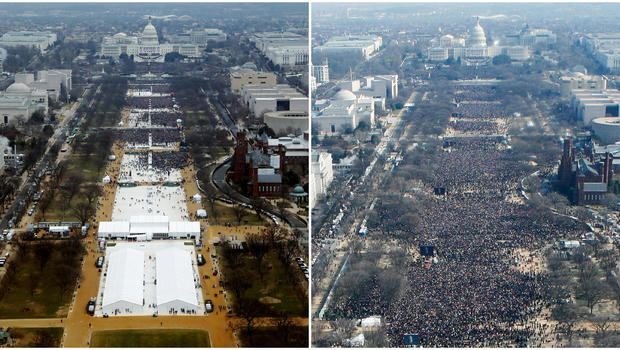
"We do know a few things, so let's go through the facts."
"We know that from the platform where the President was sworn in, to 4th Street, it holds about 250,000 people. From 4th Street to the media tent is about another 220,000. And from the media tent to the Washington Monument, another 250,000 people. All of this space was full when the President took the Oath of Office."
Well, we have photographic evidence that all of the space wasn't full when the President took the Oath of Office. So not only is Mr. Spicer making up numbers, immediately after telling all of us that there are no numbers to be had, but then he is blatantly lying about something we have objective evidence about. But wait, there's more:
"We know that 420,000 people used the D.C. Metro public transit yesterday, which actually compares to 317,000 that used it for President Obama's last inaugural. This was the largest audience to ever witness an inauguration -- period -- both in person and around the globe."
Wait, what? We don't have any numbers and never will somehow just led to a definitive (note the use of the word "period" in his statement) declaration of this being the largest inaugural audience ever. Oh, and also, those numbers he just quoted are, just as you might guess, completely inaccurate, because Spicer quoted the full day D.C. Metro number for Trump's inauguration day, but then quotes the number of riders in 2013 only through 11am (for Obama's second inaugural). If we go through 11am the numbers are Trump 193,000 against 317,000 for Obama's second inaugural. If we go for the full day numbers it would be Trump 570,000 against 782,000 for Obama's second inaugural (and a whopping 1.1 million for Obama's first inaugural, which is a more apt comparison anyways).
Spicer goes on about other inaccuracies, and I could write about all of them, but this is already longer than I wanted. Ultimately Spicer lays this line out there:
"There's been a lot of talk in the media about the responsibility to hold Donald Trump accountable. And I'm here to tell you that it goes two ways. We're going to hold the press accountable, as well."
And now, my head spins and I get a little sick to my stomach. Free press, to help hold our leaders accountable, is a hallmark of this country and our way of life. It seems that Spicer thinks that by coming to the podium, giving one small bit of truth regarding the erroneous report that Dr. King's bust had been removed. and then blatantly lying and making stuff up, he is holding the press accountable. What he has done, instead, is indicate that this Administration will attempt to live in a post-factual world. That can't be much of a surprise, as that is all Donald Trump did throughout his campaign to win the Presidency. But it has to be disheartening to the few who were holding out hope that he might pivot towards reality.
The most shocking thing of all this (although, again, it can't be surprising), is that Trump is this obsessed with meaningless things. He is President, barring his death or removal from office, for four years, at least. If only half of the people who did show up for his inauguration had showed up, who cares? This isn't a reality TV show, nor a popularity contest. The man is now the leader of the most powerful nation on Earth, and he spent much of his first 48 hours in office fixated on how to make the number of people who attended his inauguration, and who watched it, seem bigger than it actually was. Numbers are objective. By any objective measure his inauguration was less attended and watched than many before it. There were far fewer people in town for his inauguration than were in town for the Women's March the day after. These are facts. This shouldn't be a surprise, because this administration comes to office as the most unpopular in modern times, and with the weakest mandate ever. He lost the election by over three million votes. He won the Electoral College, so he earned the office in that way, but he does not have any mandate to speak of. What Trump needs to figure out, and fast, is that his legacy, and the well being of our country, will depend on his actions, not the "ratings," however he perceives them.
Unfortunately, I'm not optimistic that will be the case. On Sunday Kellyanne Conway, Trump's counselor, told NBC's Meet the Press moderator, Chuck Todd, that what Spicer did wasn't lie. What he did, instead, was present "alternative facts." Todd, rightly, pointed out that alternative facts are falsehoods. Needless to say, we need the press now more than ever, especially if the Trump Administration's standard operating procedure is going to be to make stuff up as it suits them. And especially because the Alt-Right echo chamber will be there to amplify whatever they make up to people who don't have the desire or ability to think critically on their own.
Sunday, January 22, 2017
Welcome to The Moderate Point of View
Hello there. Welcome to my new blog. I've written on the internet for sometime, on and off again. Today I decided to launch a new place to write about politics. Anyone who has been paying attention to the nature of political discourse in this country over the last two plus decades should be able to recognize the way that things have been going isn't good. Starting with the Clinton administration, driving through the Bush administration, and recently climaxing with the transition from President Obama to our newest President, Donald J. Trump, the state of political discourse in this country has gone from bad, to worse, to outright toxic.
I have many thoughts on this, and many opinions to share. For the purposes of this introduction, I'll simply say this: I hope that some of my thoughts can help in some way. We live in an imperfect world; we all know that. We all have our own "hot button topics," and we consciously partake in the hot take culture that we, through out patronage and clicks (on the remote or internet), have created. I fear, however, that we've gone too far with the nature of this last election, and the road that lays ahead of all of us over the next four years. If we are to take an active part in this democracy then it is up to us, the people of this country, to push and push hard for the brighter future we all desire. We are, undoubtedly, stronger together than apart.
I will declare this up front: I am not a Donald Trump supporter. I cannot imagine what it would have taken to get me to vote for the man. I want to own that, in this post, so that anyone who might want to accuse me of being anything, in light of this declaration, can have at it. I identify as a moderate Republican, lining up more as an independent these days than anything else. My voting history is just that: mine. I'm not going to use this space to look backwards, at least not too often I hope. The goal here is to look accurately at the present, and project what might come in the future. Looking backwards is helpful of course; those who don't are often doomed to repeat the same mistakes that their ancestors made. But, throughout this entire exercise I hope to bring a moderate, rational point of view to a discourse that has become increasingly polarized, irrational, and hate filled in the last two decades.
I welcome your thoughts and comments. You can leave them on the blog itself, or send me an email directly. I cannot promise how often I'll find the time to post here, but I will also utilize the twitter handle @themoderatepov to comment on the world around us. I hope that this can become a part of a broader discussion, at least within my own small world, to enhance the nature of discourse and, in my own way, to help us all get back on track. The future of our society very well may depend on it.
I have many thoughts on this, and many opinions to share. For the purposes of this introduction, I'll simply say this: I hope that some of my thoughts can help in some way. We live in an imperfect world; we all know that. We all have our own "hot button topics," and we consciously partake in the hot take culture that we, through out patronage and clicks (on the remote or internet), have created. I fear, however, that we've gone too far with the nature of this last election, and the road that lays ahead of all of us over the next four years. If we are to take an active part in this democracy then it is up to us, the people of this country, to push and push hard for the brighter future we all desire. We are, undoubtedly, stronger together than apart.
I will declare this up front: I am not a Donald Trump supporter. I cannot imagine what it would have taken to get me to vote for the man. I want to own that, in this post, so that anyone who might want to accuse me of being anything, in light of this declaration, can have at it. I identify as a moderate Republican, lining up more as an independent these days than anything else. My voting history is just that: mine. I'm not going to use this space to look backwards, at least not too often I hope. The goal here is to look accurately at the present, and project what might come in the future. Looking backwards is helpful of course; those who don't are often doomed to repeat the same mistakes that their ancestors made. But, throughout this entire exercise I hope to bring a moderate, rational point of view to a discourse that has become increasingly polarized, irrational, and hate filled in the last two decades.
I welcome your thoughts and comments. You can leave them on the blog itself, or send me an email directly. I cannot promise how often I'll find the time to post here, but I will also utilize the twitter handle @themoderatepov to comment on the world around us. I hope that this can become a part of a broader discussion, at least within my own small world, to enhance the nature of discourse and, in my own way, to help us all get back on track. The future of our society very well may depend on it.
Subscribe to:
Posts (Atom)